R-03 Foundry & Azure
Application landing zones become workload landing zones – five CAF scenarios vanish
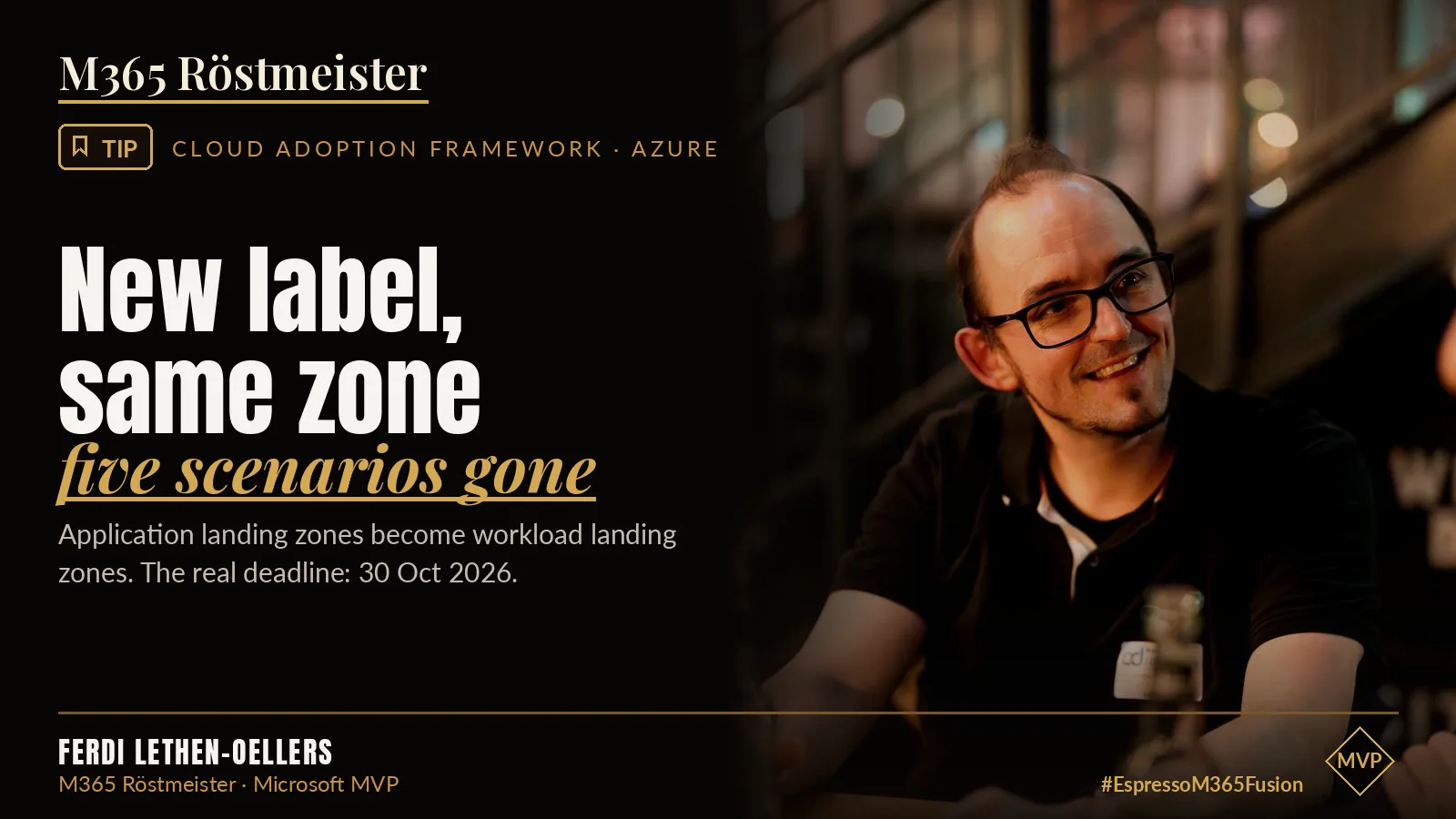
The CAF scenarios for AVD, SAP, Hybrid/Multicloud and Oracle disappear. Harbingers on 30 September 2026: the “Modern app platform” scenario goes away, and Azure Virtual Desktop (classic) is retired. Save what you need now.
Microsoft renames one word in the Cloud Adoption Framework, and the architect bubble starts discussing. A few lines above, on the same What’s-new page, it says: the CAF guide for Azure Virtual Desktop disappears on 30 October. Almost nobody talks about that.
Both deserve your attention. In an architecture review I co-wrote for a customer, “Application Landing Zone” shows up seventeen times. And I bet somewhere in your playbooks there is a link to a CAF scenario that will be gone in a few weeks.
What Microsoft actually announced
First, the good news: the rename is announced, not done. Microsoft lists it as a roadmap item. Today, Learn still says “Application (workload) landing zones”, both terms side by side.
And Microsoft says it explicitly: scope and intent don’t change. The workload landing zone is the same zone as before. Workload teams deploy and run their resources there, inside the guardrails of the platform landing zone.
So why the new name? Because “application” was always fuzzy. A data platform is not an application. An AI pipeline isn’t either. Learn itself says any kind of workload lands there, including AI. “Workload” is exactly the term the Well-Architected Framework has used for years: a collection of resources that together support a business goal.
For you this means: workload assessments and landing zone docs finally speak the same language. Sounds trivial. But it saves you a lot of “do you mean the same thing with application and workload?” rounds in the architecture board.
You find all announcements on the official page What’s new in Microsoft’s Cloud Adoption Framework on Microsoft Learn.
Why this is more than cosmetics
On its own, the rebrand is cosmetics. In context, it is part of a rebuild that has been running for months:
- March 2026Cloud-scale analytics is outReplaced by new guidance for a unified data platform with Microsoft Fabric.
- April 2026Accelerator articles deprecatedThe CAF articles for the application landing zone accelerators, e.g. AKS, App Service, Container Apps and API Management.
- May 2026Accelerator articles deletedThe GitHub repos with the deployments stay available.
- June 2026Platform accelerator changes ownerThe platform landing zone accelerator moves to the Azure Migrate team.
- September 2026Five scenarios deprecated, new terms announcedOn top, the terminology change and a new version of the landing zone guidance are on the roadmap.
The direction is clear. CAF becomes a roadmap for decision makers. How you actually build a workload will live in the Azure Architecture Center, in the WAF and in the product docs. CAF and WAF are not merging, they are splitting the work more cleanly. The new term is the language glue between them.
To be fair: Microsoft communicates this transparently. With dates, with reasons, with instructions on how to keep a copy. The blind spot: all of this sits on a What’s-new page that hardly anybody follows. There is no Message Center for CAF. If you don’t check actively, you notice it when the link in the customer playbook goes nowhere.
The deprecation window: these scenarios disappear
| Last day | Scenario | What you should do |
|---|---|---|
| 30 September 2026 | Modern app platform | Save it right now if you reference it |
| 30 October 2026 | Azure Virtual Desktop · SAP on Azure · Hybrid and multicloud · Oracle on Azure | Inventory your links, save the content you need, point references to Architecture Center, WAF or product docs |
The CAF guidance disappears, not the product. AVD keeps running, only the old classic version is retired on 30 September. But if you justified AVD design decisions with a link to the CAF scenario, that justification will soon point to a dead page. Especially in the modern workplace space, this hits more documentation than you think.
What you should do now
cloud-adoption-framework/scenarios/, especially app-platform, azure-virtual-desktop, sap, hybrid and oracle-on-azure.Application Landing Zone, build a list of all hits, then prioritize: customer-facing first, internal playbooks later. For the transition, write “Workload (Application) Landing Zone”. Microsoft does it the same way, and nobody feels left behind.How subscriptions, resource groups and Bicep parameters work together in practice is something I show in SocialHub with Azure.
Cosmetics or change of strategy?
Both. Technically, nothing changes in your landing zone. Subscriptions, management groups and policies stay where they are. Strategically, Microsoft cleans up CAF: less build manual, more decision framework. For us architects that’s good. We will know more clearly where which question gets answered.
The flip side: if you used CAF as a reference for concrete scenarios so far, you have to relearn. That’s not trivial, especially when your customer processes pointed to these pages for years.
What stays
The term change is announced, harmless and makes sense. The scenario deprecations are concrete, dated and running out right now. If you only talk about the word, you miss the deadline.
The bean stays the same, only the label on the bag changes. It gets embarrassing when you serve the customer an espresso in the review from a bag the shop doesn’t sell anymore.
- Search your docs now for links to the five deprecated CAF scenarios and save what you need. Modern app platform is gone on 30 September.
- Move from “Application Landing Zone” to “Workload Landing Zone” step by step, customer-facing documents first.
- During the transition, use “Workload (Application) Landing Zone”, just like Microsoft does.
- Don’t touch management groups or subscriptions just because a documentation term changes.
- Take the rebrand as a reason for a real role review: workload owner, platform owner, RACI.
- Put the CAF What’s-new page in your calendar as a fixed appointment. There is no Message Center for it.
Are you in the middle of a similar switch right now? Tell me on LinkedIn which stumbling blocks showed up for you.
#EspressoM365Fusion

Senior Modern Workplace Consultant at amexus, Microsoft MVP, author of “Microsoft 365 Administration für Dummies”.